


Case study 02 / Articulate Storyline
The Expert Is Leaving in 30 Days
A scenario-based learning experience that asks leaders to protect critical knowledge, prepare a capable employee to step up, and make deliberate transfer decisions before time runs out.
- Project type
- Interactive workplace simulation
- Audience
- Managers, team leads, and professionals responsible for knowledge continuity
- My contribution
- Instructional design, scenario writing, storyboarding, visual design, interaction design, and Storyline development
- Status
- Independent portfolio project · In development
The challenge
Thirty days to protect knowledge the team cannot afford to lose.
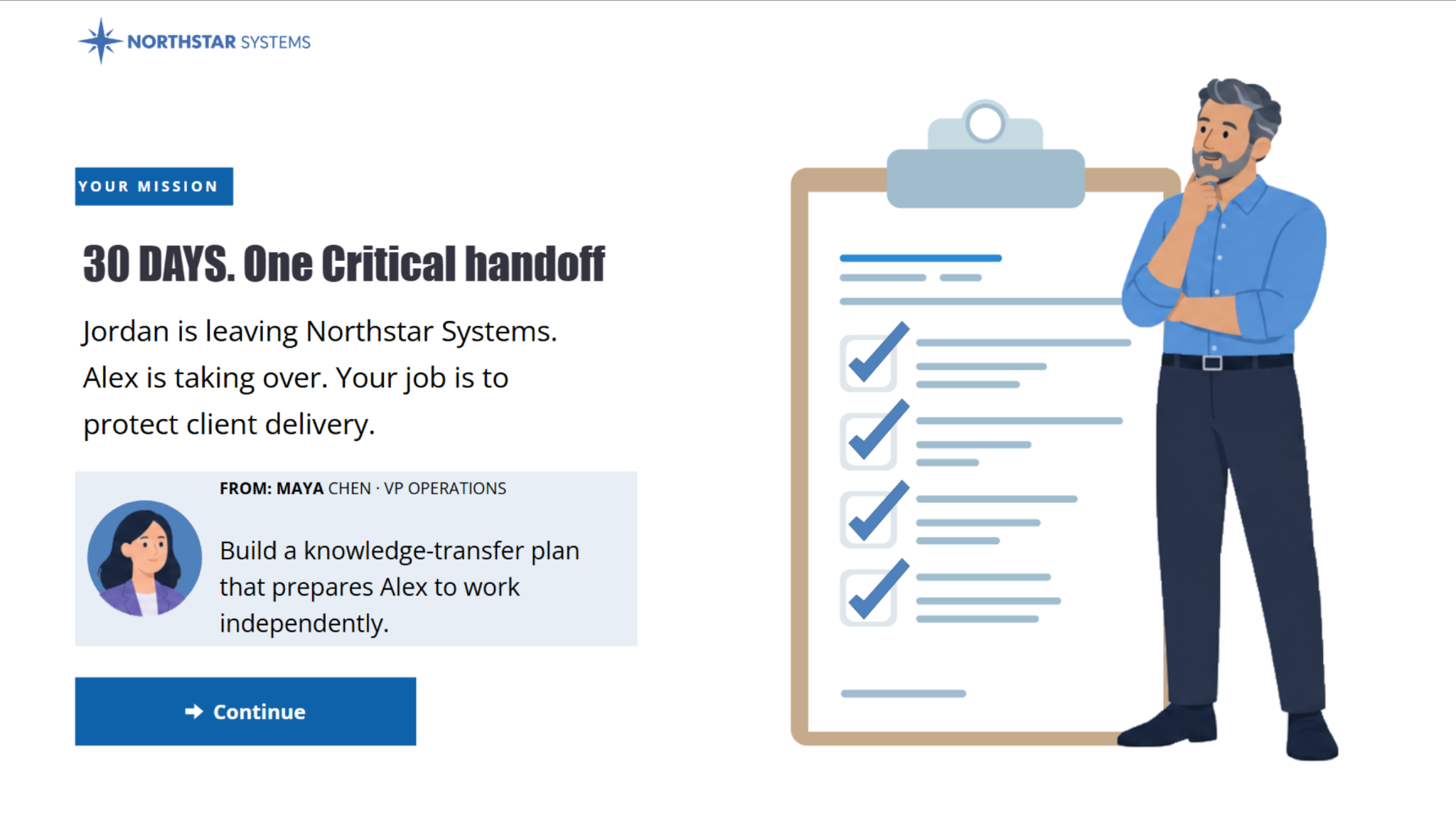
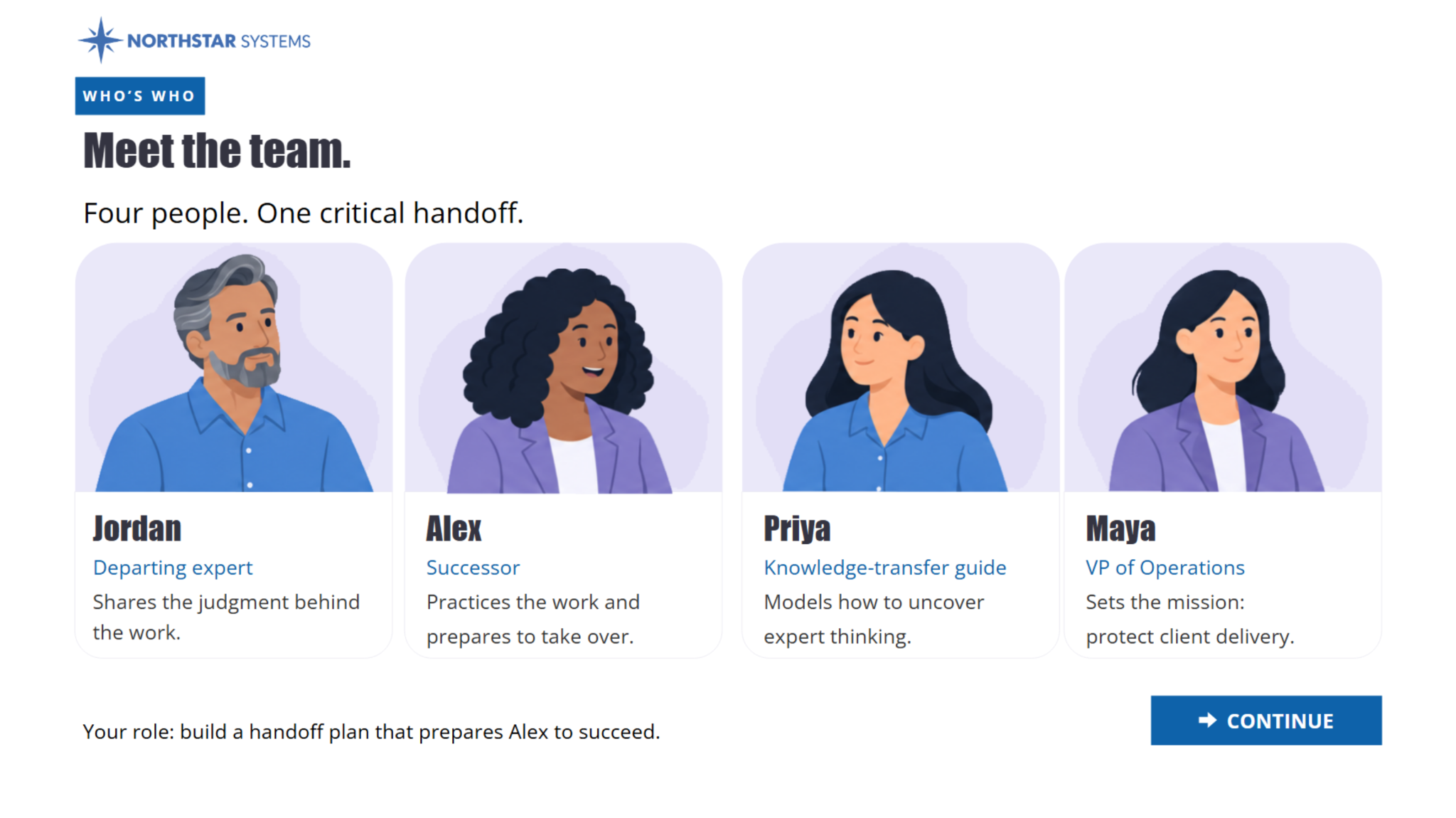
Jordan, a Senior Implementation Specialist, is leaving in 30 days. Much of the knowledge required to lead complex implementations lives in Jordan's experience: judgment, workarounds, stakeholder context, and the ability to recognize problems before they escalate.
Alex, an Implementation Analyst, is capable and ready to grow, but needs structured guidance and meaningful practice. The learner's assignment is to build a transfer plan that protects the business while preparing Alex to take greater ownership.
Expert knowledge→Critical priorities→Guided practice→Team continuity
The learner's starting point
A strong time window with uneven readiness.
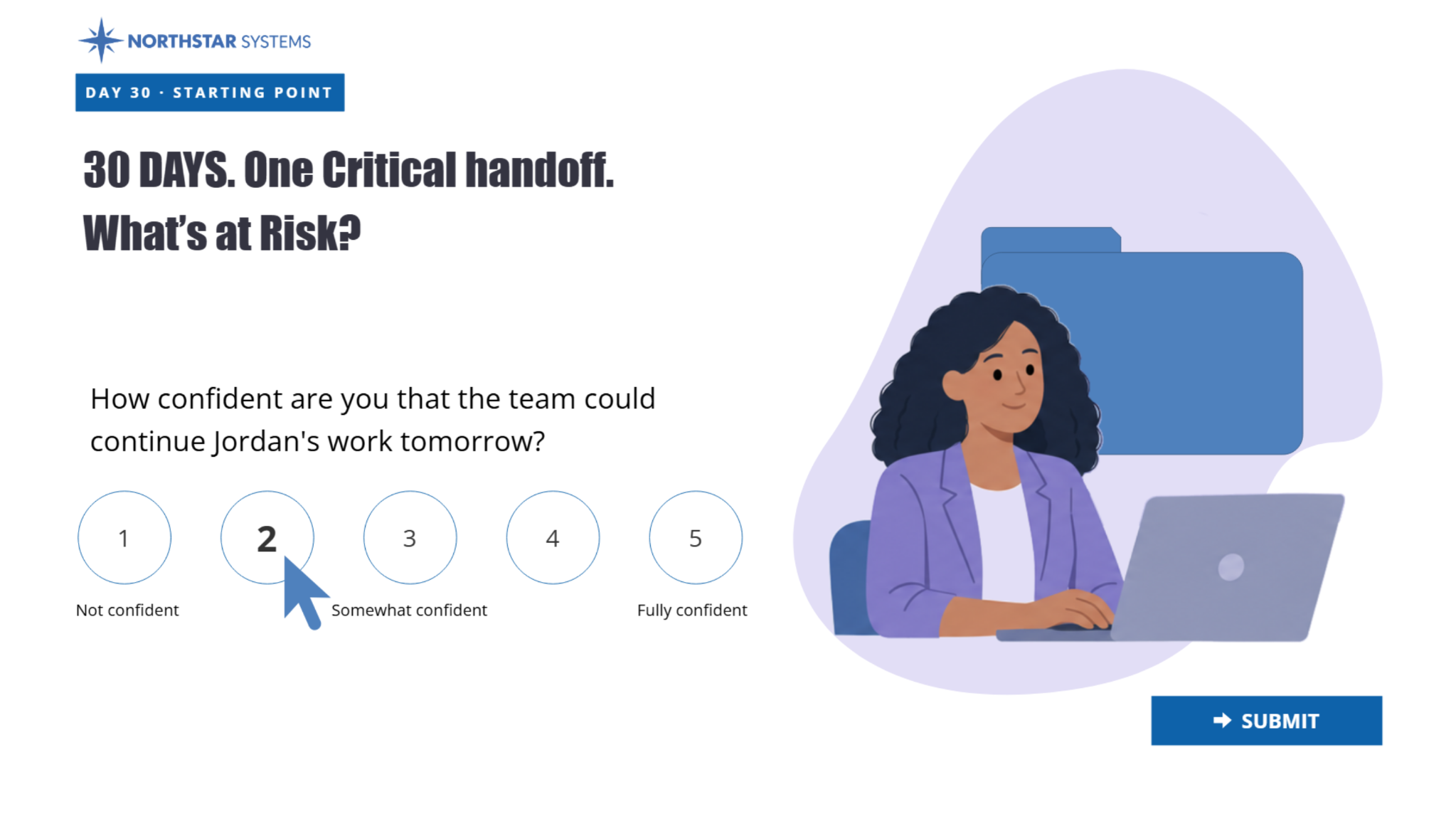
The opening dashboard makes the performance problem concrete. Time begins at full strength, while continuity, readiness, and quality reveal where the transfer plan needs attention. The learner must use the remaining days wisely instead of treating documentation as the entire solution.
The design response
A workplace simulation built around judgment, not information alone.
Make the risk immediate
A 30-day countdown turns an abstract knowledge-management problem into a time-bound performance challenge with visible consequences.
Give the learner a real assignment
The learner must protect business continuity while preparing Alex to lead complex implementations, rather than simply recalling information about knowledge transfer.
Make priorities visible
A current-state dashboard tracks continuity, readiness, quality, and time so each decision can be evaluated against the larger goal.
Practice judgment
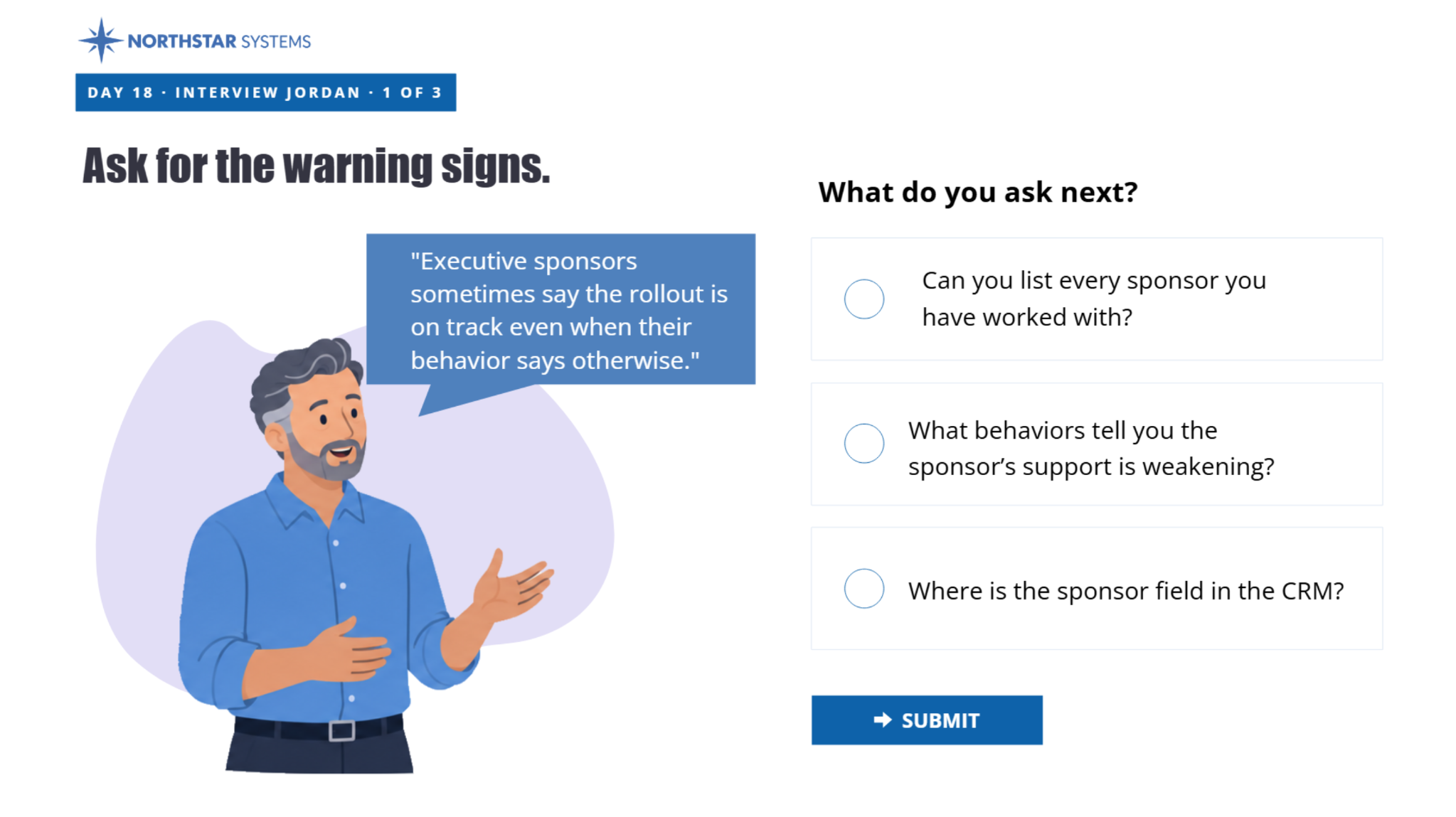
Multiple-choice decisions, prioritization activities, and drag-and-drop planning ask learners to decide what to capture, transfer, practice, and verify.
Inside the experience
Six moments that move the learner from urgency to a defensible plan.
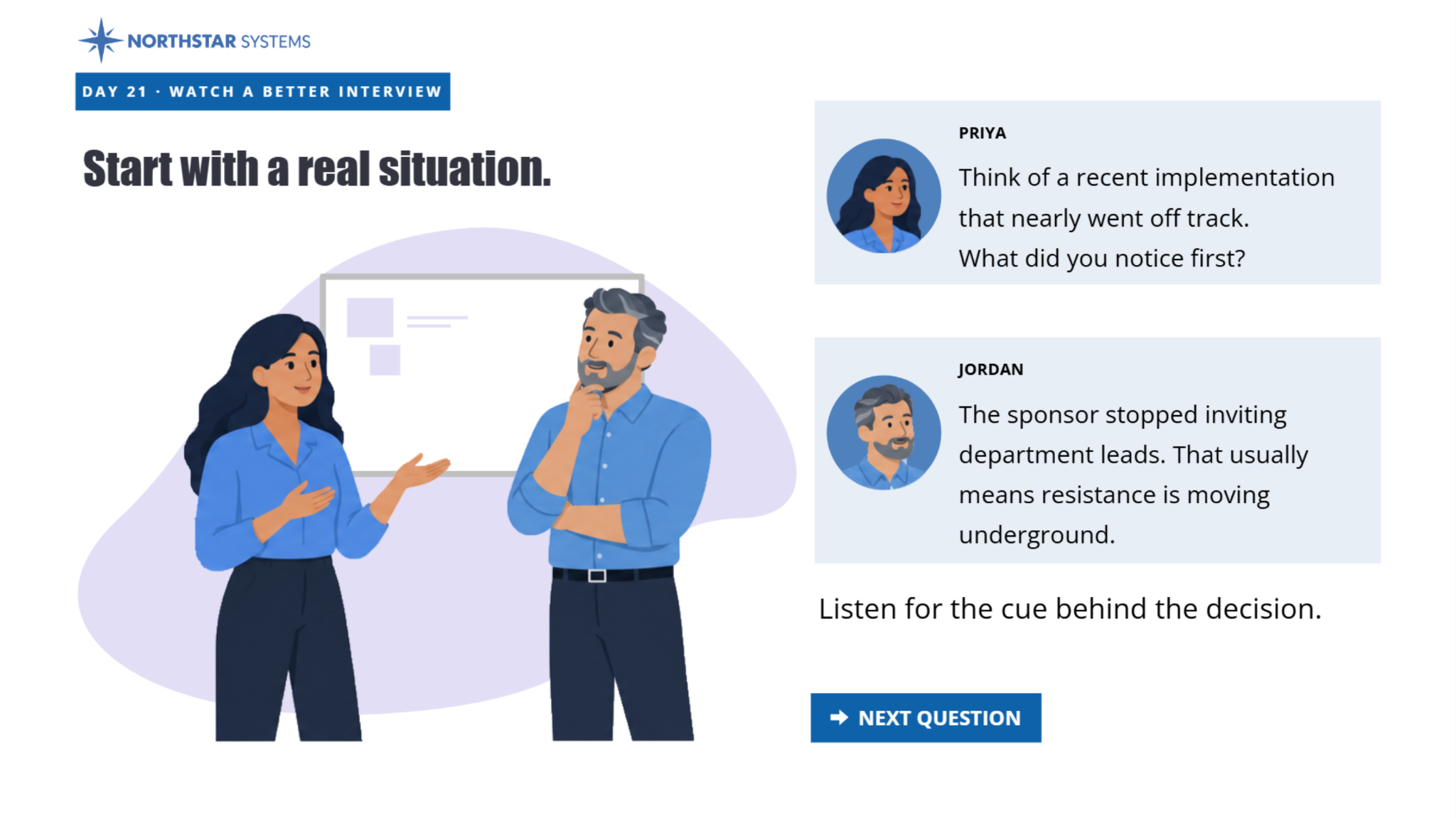
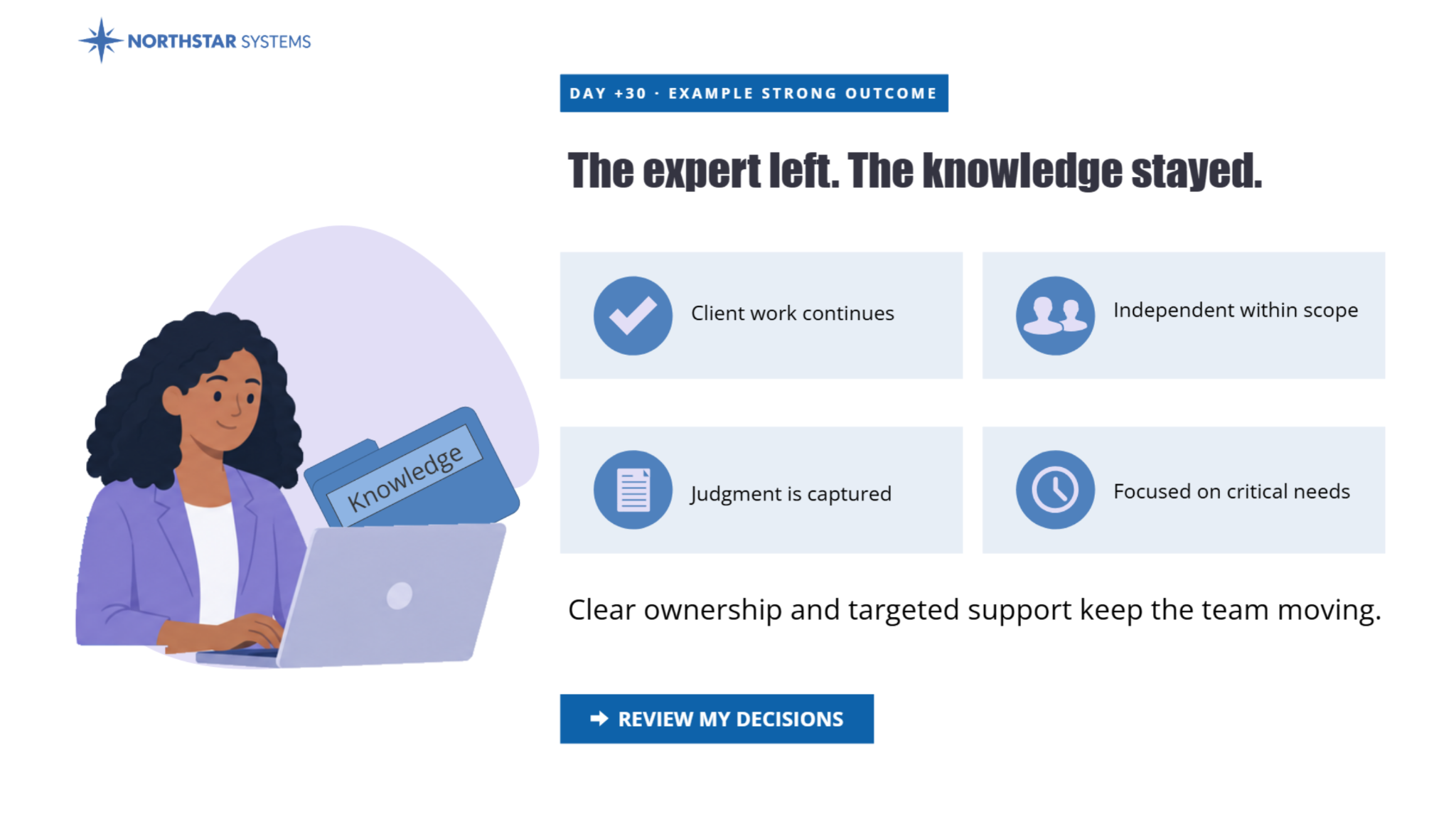
Together, these screens show how the experience moves from urgency and context into guided questioning, decision practice, and a clear knowledge-transfer outcome.
What this project demonstrates
Scenario-based learning
A credible workplace situation gives every interaction a practical reason to exist and keeps the experience focused on performance.
Performance-centered design
The course begins with what the learner must accomplish: preserve essential knowledge and prepare another employee to perform.
Information prioritization
Learners distinguish mission-critical expertise from information that can be documented, delegated, or learned later.
Practice and feedback
Decisions are followed by targeted feedback that explains the tradeoffs and connects choices to continuity, readiness, and quality.
Visual learning system
A restrained corporate interface, persistent day counter, dashboards, cards, and status indicators make the scenario easy to navigate.
Storyline development
The project translates a storyboard into an interactive Articulate Storyline experience with reusable layouts and interaction patterns.
My role and tools
Designing the learning strategy and building the experience.
This is an independent portfolio project developed to demonstrate my end-to-end process, from defining the performance challenge through visual design and Storyline production.
- Defined the workplace performance problem and learner role
- Created the scenario, characters, dashboard, and 30-day structure
- Designed decision points, prioritization activities, and feedback
- Built the storyboard and reusable visual system
- Developing the interactive experience in Articulate Storyline 360
- Using Adobe Creative Suite for supporting visual assets
Current status
An in-progress prototype connecting knowledge transfer to observable decisions.
The storyboard and visual direction establish a complete scenario arc, including the assignment, team context, current-state dashboard, decision activities, and final results screen. Storyline development is currently underway.
Because the project has not yet been tested with learners, this case study does not claim performance outcomes. The next phase is to complete the interaction build, test usability and decision clarity, and refine the experience using feedback.
Performance challengeScenario and characters24-screen storyboardDashboard systemDecision activitiesDrag-and-drop planningFeedback statesStoryline prototype
Continue exploring